A vault is not a cover.Here is the physics.
FloodVault is engineered around three principles: a continuous waterproof envelope, a sealed-base perimeter that resists hydrostatic pressure, and a closure system borrowed from professional drysuit and military survival gear.
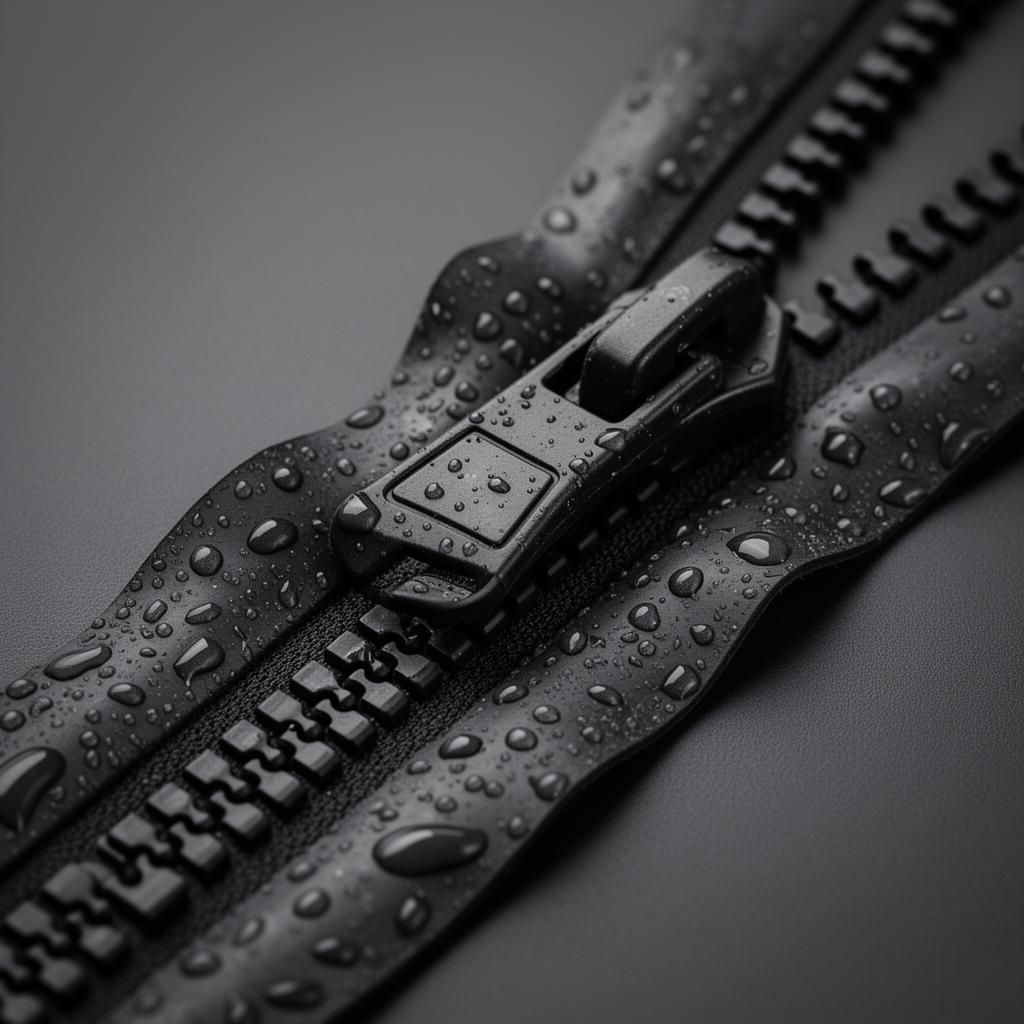
TIZIP® MasterSeal
A standard zipper has gaps measured in millimeters at every tooth. Water finds those gaps in seconds. The TIZIP MasterSeal is a different mechanism entirely: two vulcanized polyurethane lips compressed together by a sealed slider, producing a continuous airtight, watertight closure rated to the same standard as professional dive suits.
- • IP68-equivalent watertight seal at the closure
- • Tested for chemical and saltwater resistance
- • Used in NATO drysuits, hazmat suits, and submarine egress gear
ASTM-rated PVC, marine grade
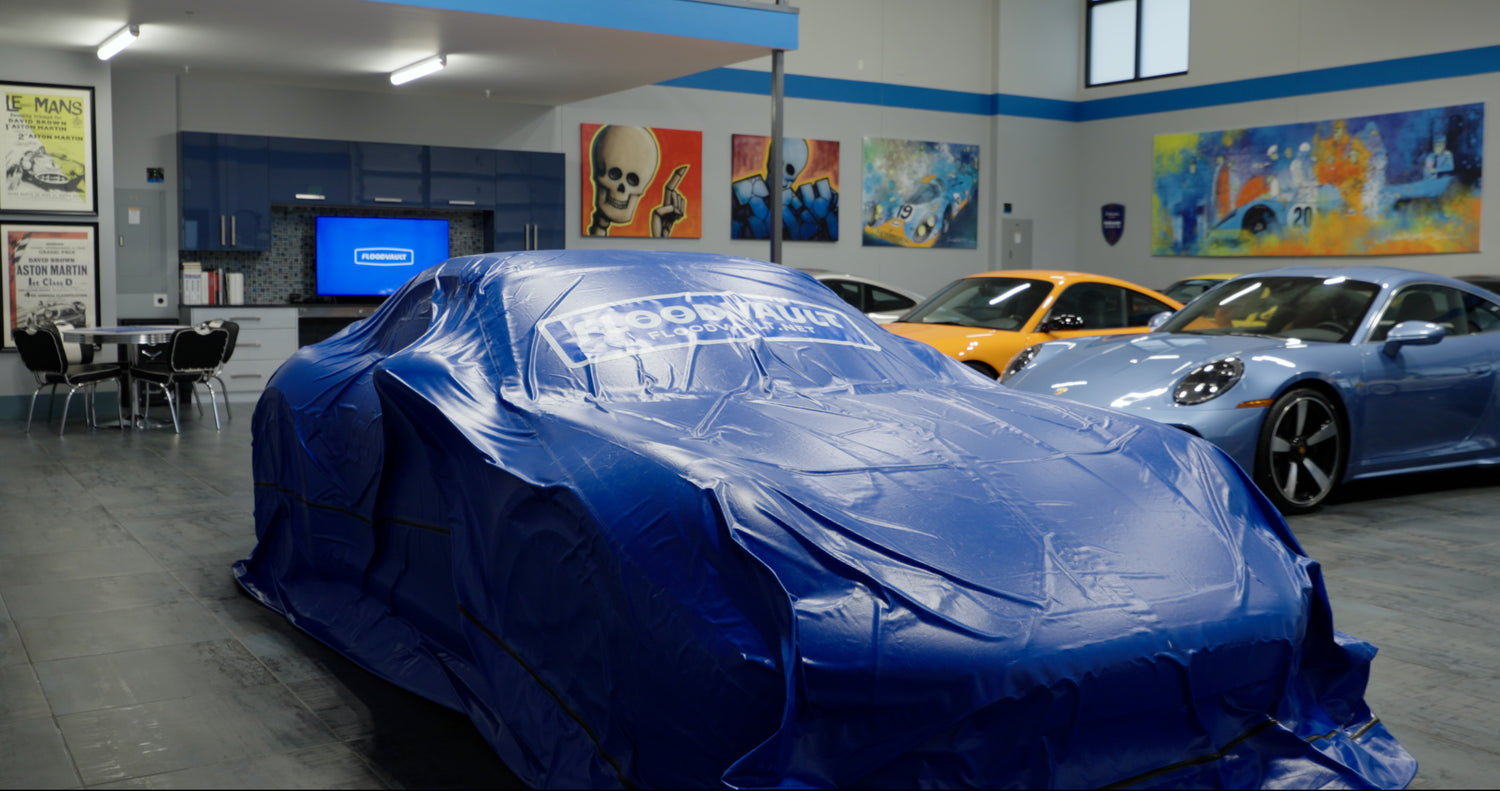
The body of every FloodVault is a single sheet of heavy-duty PVC, formulated for continuous saltwater exposure and engineered to maintain integrity under sustained hydrostatic load. Seams are radio-frequency welded — not stitched, not glued — producing a continuous waterproof membrane around the entire vehicle.
The sealed-base design — only from FloodVault.
Continuous floor pan
Most competitors are open at the bottom. FloodVault is a full envelope — bottom included — so water cannot enter from the lowest point first.
Garage floor friction
The weight of the vehicle holds the base in place. No anchoring, no straps, no power required.
Underground compatible
Storm drains reverse and underground garages flood bottom-up. A sealed-base vault works where sandbags can't even be deployed.
A sealed envelope also keeps out dust, dirt, rodents, and pests.
FloodVault is built for expected threats — first and foremost, floods. It is deployed when water is the risk. The same sealed envelope offers meaningful added protection. Leaks and drips can reach a parked vehicle long before a storm does, and rodents can also cause considerable damage — chewed wiring, nested insulation, and soiled upholstery are among the more expensive off-season losses a collector absorbs. Dust and garage grit are a another concern, but the same continuous PVC envelope and TIZIP closure that hold out floodwater also help seal off the vehicle — or motorcycle, guitar case, or crated artwork — from those everyday intrusions while the vault is deployed.
Five minutes of preparation decides how the vault performs.
FloodVault's own deployment instructions come down to two short lists. Run both before the zipper closes.
Preparation
- Close everything up
All windows and doors fully closed. Sunroof shut, convertible top up and latched.
- Remove the antenna
Any mast antenna comes off before the envelope goes over the car.
- Use a soft cloth cover underneath
FloodVault protects the car from water; a soft cloth car cover protects the finish. Always run one under the vault.
- Add a moisture absorber
A car dehumidifier bag inside the cabin takes care of the humidity sealed in with the vehicle.
Placement
- Clean, level, covered surface
Sweep the floor first — grit under the base is the most common source of abrasion. Keep the vault out of direct sunlight.
- A completely dry vehicle
No wet tires, no damp interior, no water still beading on the paint from a wash.
- A completely cold vehicle
This one matters: a warm catalytic converter can damage the vault's base. Let the car cool fully before it goes on the envelope.
The cold-vehicle rule is the one owners skip. Heat from a catalytic converter can damage the base of the vault. If you have just driven the car home ahead of a storm, give it time to cool completely before deploying.
Draw the air out. The vault becomes a second skin.
Every FloodVault has two sealed vacuum ports — front and rear — welded into the envelope. Once the TIZIP® closure is fully seated, you attach a shop vacuum to a port and draw air out only until the vault takes on the shape of the vehicle. Form-fitting, not shrink-wrapped.
- Less slack, less movement. A drawn-down vault has no loose material for wind or moving water to grab and work against the seal.
- Less trapped air. Air inside a sealed envelope wants to float. Evacuating it reduces buoyancy and keeps the vault sitting where you put it.
- Do not over-vacuum. Excess negative pressure puts undue stress on glass and body panels. Stop as soon as the envelope conforms to the vehicle's shape — tighter is not better.
- Some relaxation is normal. After several days it is expected and normal for the vault to relax a bit. That is not a failed seal — you can simply draw it down again if you want the closer fit.
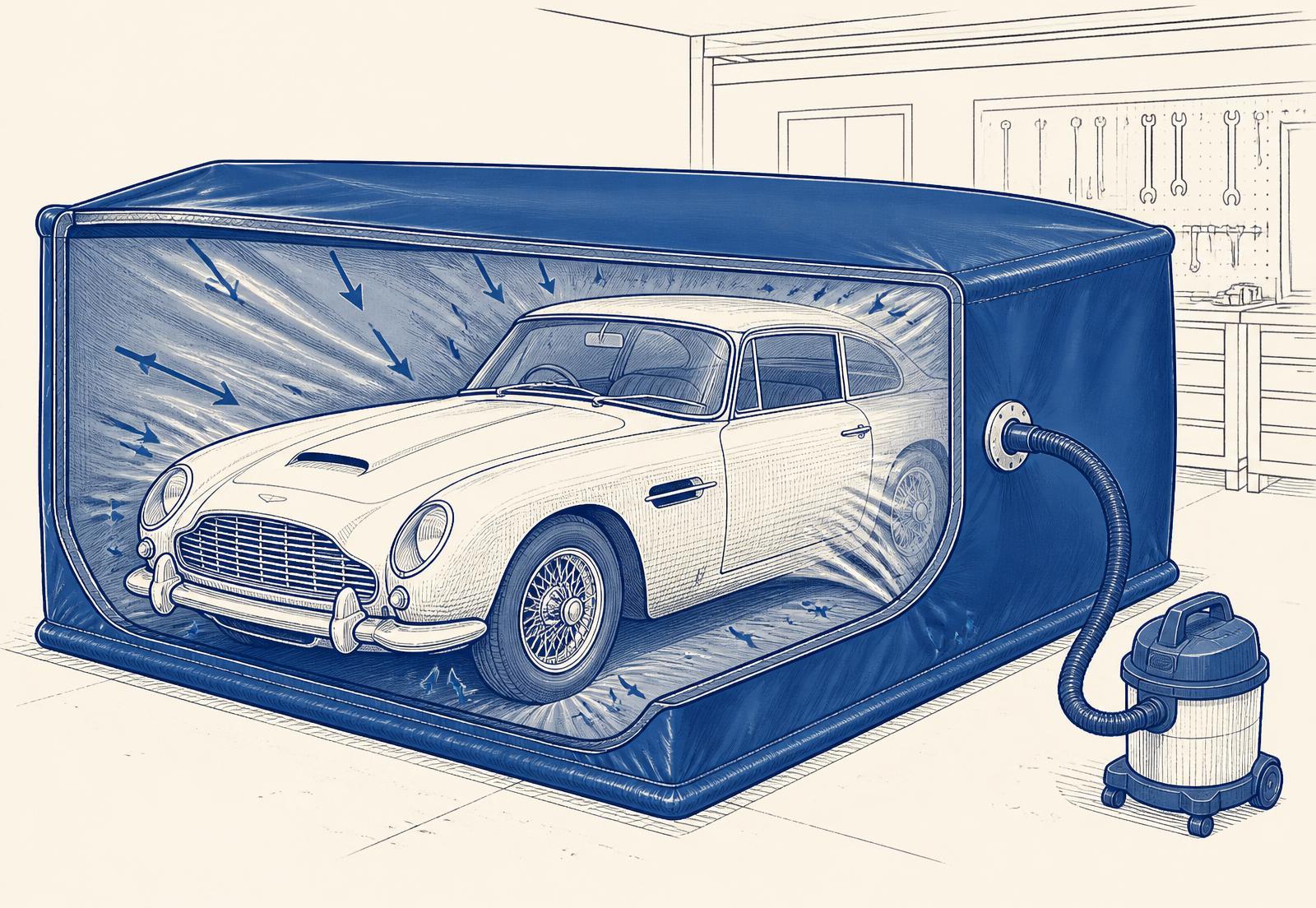
Close first
Run the TIZIP MasterSeal all the way to the stop and press the closure flat. Nothing draws down until the vault is sealed.
Uncap the port
Unscrew the vacuum port cap on the side of the envelope. Keep the cap — it's part of the seal.
Draw it down
Seat the hose on the port and run it only until the envelope conforms to the body — then stop. Over-vacuuming stresses glass and body panels.
Cap it off
Pull the hose and thread the cap back on immediately. The port is now part of the waterproof envelope again.
A cordless shop vacuum — we use the WORX 20V Power Share.
You do not need a specialty pump. Any small wet/dry shop vacuum with a hose that seats on the port will draw the vault down; FloodVault points owners to the WORX 20V Power Share unit. We recommend a cordless one for one reason: storm preparation often happens after the power has already gone out, or in a garage with no working outlet. A battery-powered vac keeps the last step of deployment independent of the grid. A corded shop vac works fine when power is available.
See the WORX 20V Power Share vacuumKeep the battery alive while the vault stays sealed.
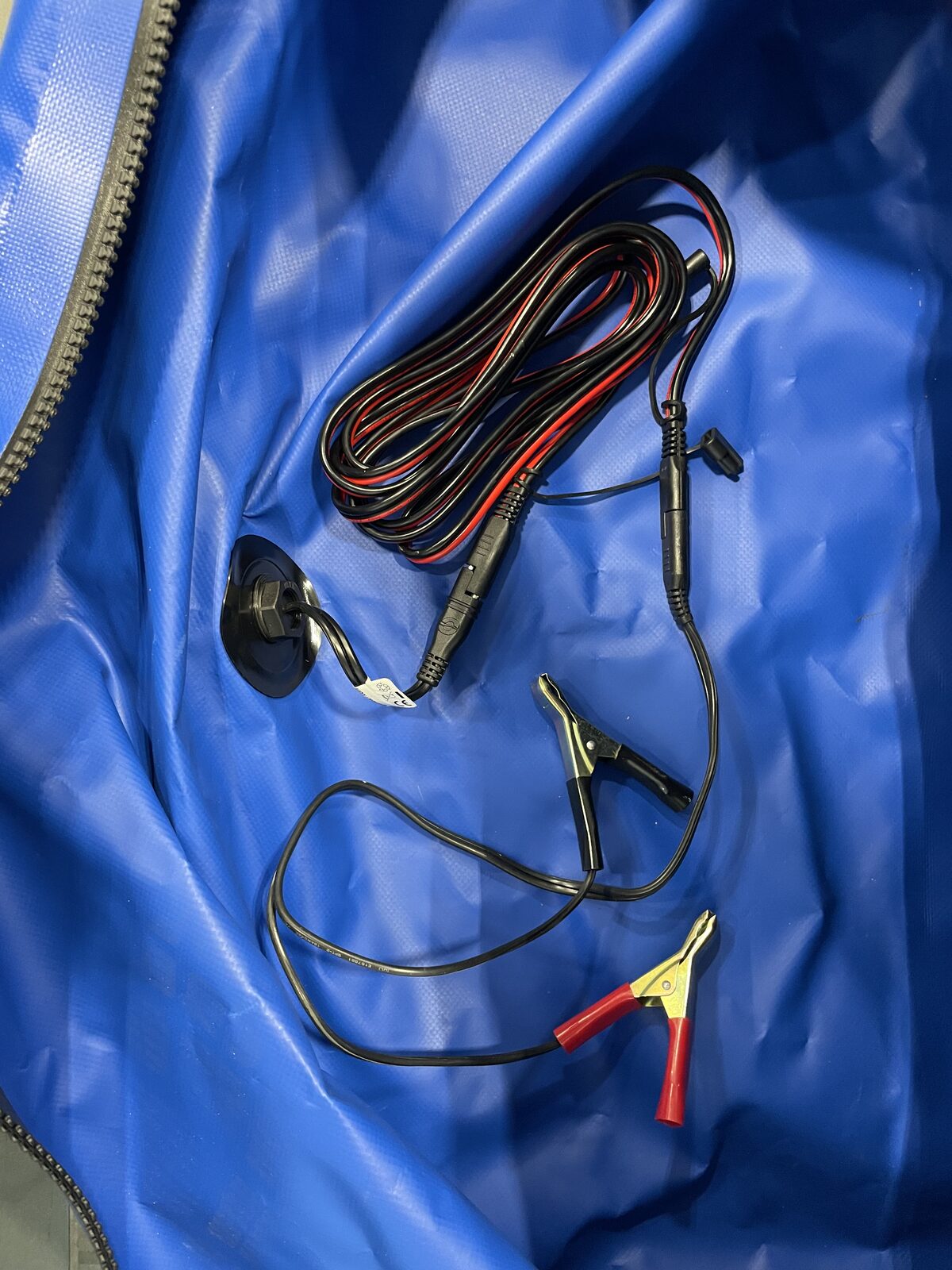
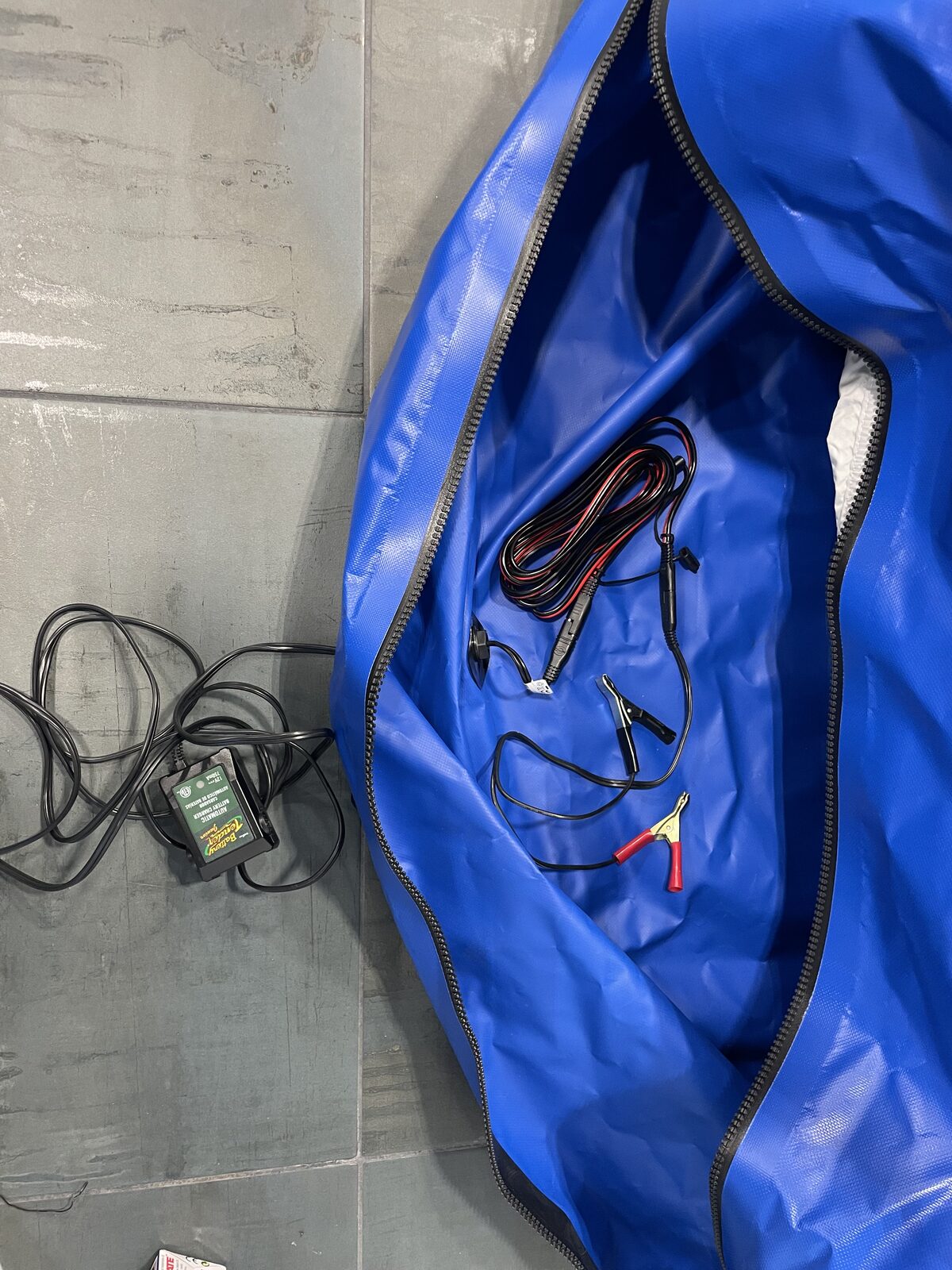
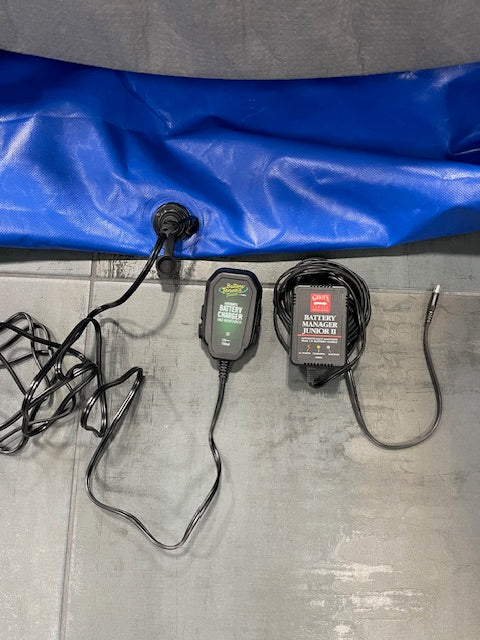
A vehicle can sit vaulted for several days through a storm watch. Modern cars, and most collector cars with an alarm or a clock, will draw a battery down in that time. So every FloodVault ships with a waterproof charging port and an interior extension cord as standard equipment — a threaded pass-through that lets a battery maintainer's lead exit the envelope without breaking the waterproof seal. Nothing to buy but the maintainer itself.
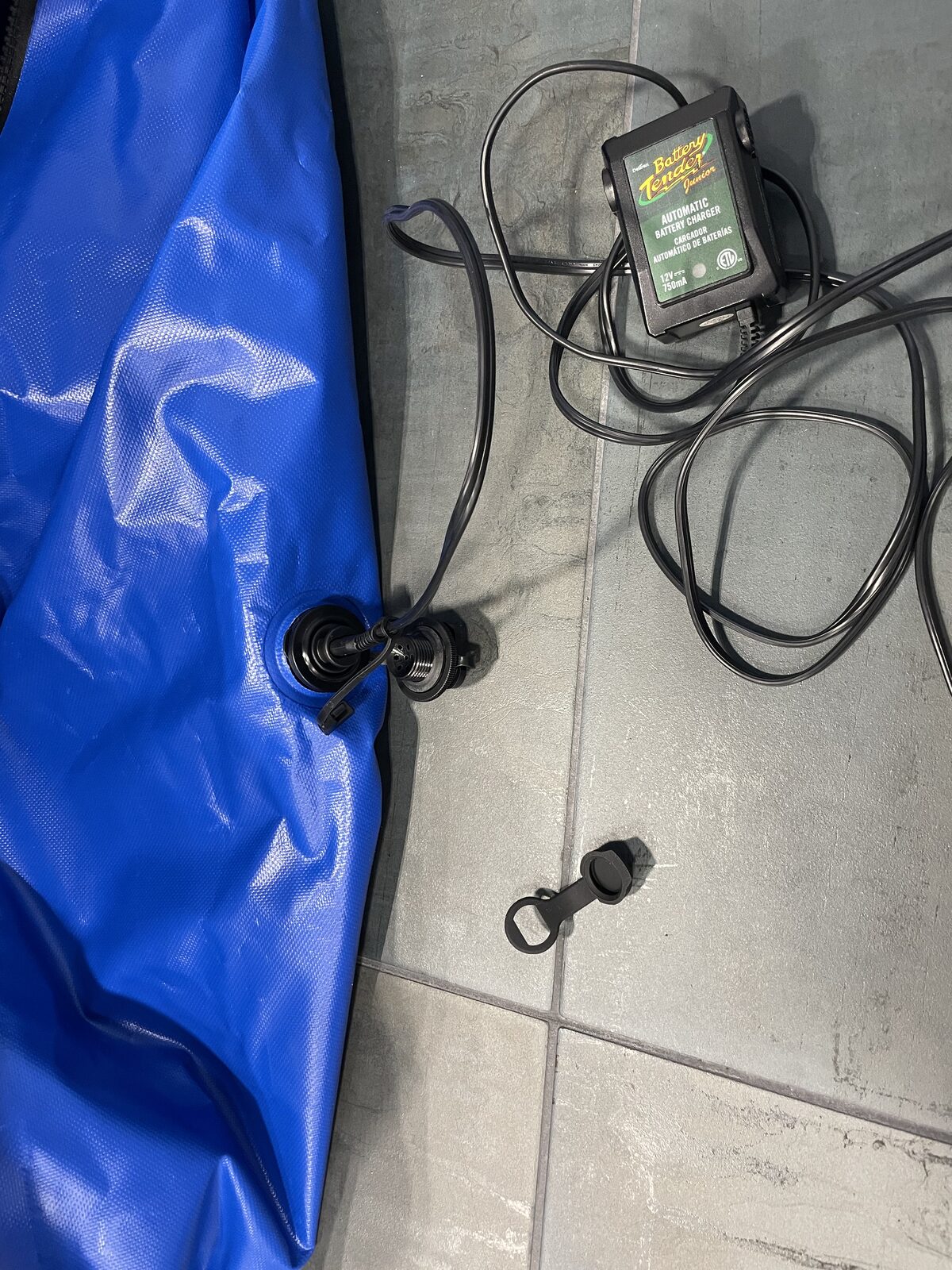
Connect before you close
Attach the maintainer's lead to the battery — ring terminals on the posts, or clips — while the vault is still open.
Route the lead out
Feed the SAE connector end through the pass-through port from the inside.
Seat the seal
Tighten the gland down around the cord so the port closes on the cable. Then close and seat the TIZIP.
Plug in high and dry
Plug the maintainer into an outlet above any water you expect. If that circuit could flood, leave it unplugged.
A float maintainer — not a fast charger.
Look for a 12V automatic maintainer or trickle charger in the 750 mA to 1.25 A range that switches to float mode on its own — the Battery Tender Junior and the Battery Manager Junior II shown above are both typical of the class. What matters is that it is automatic, low-amperage, and designed to be left connected. A high-output fast charger is the wrong tool here: it generates heat and off-gassing you do not want inside a sealed envelope.
Safety governs. Never energize a cord that runs into or through standing water, and never plug a maintainer into a circuit you expect to flood. If floodwater may reach the outlet, unplug the maintainer and accept the dead battery — it is a jump start, not a fire.
See 12V battery maintainersThe vault keeps water out. A dehumidifier bag handles what's already inside.
The FloodVault envelope itself is mildew- and rot-resistant. The vehicle inside it is not. Whatever humidity is in the air when you close the closure stays in there, and on a cool night it condenses on the coldest surfaces it can find — glass, chrome, bare metal, carpet. That is why every FloodVault deployment should include a moisture absorber.
Put it inside the car, not just the vault
FloodVault's own instruction: place a car dehumidifier bag inside the automobile to absorb any remaining moisture while it is covered. The cabin is the space that holds humidity and the interior is what mildew ruins first. For a vault holding boxes or gear, tuck a bag in with the load instead.
Start dry and cold
Load a completely dry vehicle — no wet tires, no damp floor mats, no fresh wash beading on the paint. A cold vehicle, too: a warm engine bay drives moisture into the air inside the envelope as it cools.
Recharge between events
Most car dehumidifier bags are rechargeable — dry them out in an oven or microwave per the manufacturer's directions and they are ready for the next watch. Check the indicator before you seal, not after.
Rechargeable car dehumidifier bags.
These are the four product lines FloodVault points owners to. Any rechargeable silica-gel car dehumidifier bag of comparable capacity does the same job — size it to the cabin, and use two in a large sedan or wagon.
Listed because FloodVault's own deployment instructions name them. FloodVault does not manufacture or warrant third-party absorbers.
A flood vault, not a storage cover.
FloodVault is event protection. It is built to be deployed when water is the threat — a named-storm watch, a flash-flood warning, a river crest, a hurricane evacuation — and opened again once the threat has passed. It is not designed, sold, or warranted as a season-long or indefinite storage cover.
The reason is physics, not a defect. Any sealed, waterproof envelope holds whatever humidity is inside it when you close it. Left sealed for weeks or months — especially outdoors, in sun, with day-to-night temperature swings — that trapped moisture condenses on cool surfaces. On a vehicle that can mean mildew on upholstery, musty carpet, surface corrosion on bare metal, and mold. We would rather tell you that plainly before you buy than have you discover it after a season.
Do
- • Load the vehicle clean and completely dry — no wet tires, no damp interior.
- • Deploy inside the watch/warning window, ideally 24–48 hours ahead.
- • Add a desiccant pack inside the envelope for multi-day deployments.
- • Unseal, open, and air everything out once the water risk is over.
- • Rinse, dry fully, and fold the vault away indoors between events.
Don't
- • Don't use FloodVault as a winter, seasonal, or indefinite storage cover.
- • Don't seal a wet, freshly washed, or dirty vehicle inside it.
- • Don't leave a vault sealed outdoors in direct sun for extended periods.
- • Don't treat it as a substitute for a climate-controlled storage space.
- • Don't fold and store the vault damp.
Moisture damage that results from long-term sealed storage is a use condition, not a product defect, and is not covered under the FloodVault warranty. If you need months of protection rather than days, keep the vault for the event window and use a breathable indoor cover the rest of the time.