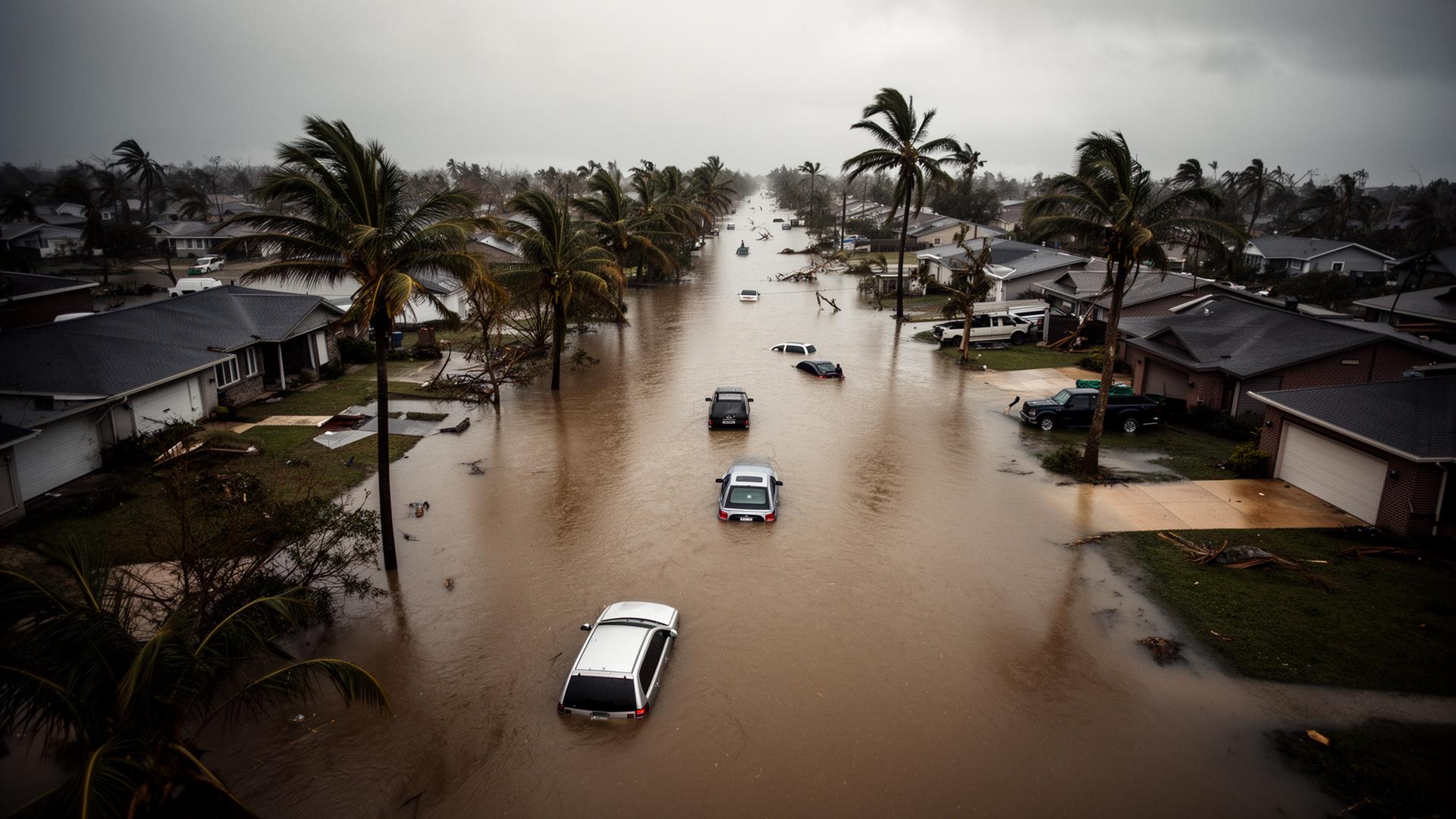
How to protect a carfrom flooding.
If you can drive it somewhere dry, do that. This guide is for the car you can't move — and for the honest question underneath it: what happens when the garage barrier doesn't hold?
Protection is layered, and every layer happens before the water.
Flood protection for a vehicle works the way flood protection for anything else works: you stack independent layers, and you assume each one can fail. Moving the car is the strongest layer and the one that runs out first. Defending the building is the second. Sealing the car itself is the third — and it is the only layer that still works when the first two don't.
A vault is not a response to a failed barrier. Once water is in the garage it is already too late to seal a vehicle — the car must be dry, cool and clean when it goes in. You deploy the vault before the flood, so the car is already protected if and when the barrier gives way.
Three layers. Only one of them protects the car.
Move the car, if you actually can
The best flood protection is elevation and distance. If the car is registered, running and there is somewhere dry to take it, drive it there. This is the layer most collectors run out of first: multiple cars, one driver, a closing evacuation window.
Defend the building
Door barriers, flood panels, sandbags, sump pumps and backflow valves. These reduce how much water enters and buy time. FEMA's dry-floodproofing guidance generally caps this approach at about three feet of depth — beyond that, hydrostatic pressure becomes the problem rather than the water.
Seal the car itself — before the water arrives
A FloodVault is deployed while the car is dry, cool and clean, ahead of the event. It does not depend on the slab, the door seal, the drains or the power staying on. If the barrier holds, you unseal it and nothing happened. If the barrier does not hold, the car was never in the water.
What is the failure rate of a garage flood barrier?
We looked for a credible number and we are not going to invent one.
There is no published, industry-wide failure rate for residential garage flood barriers. Anyone quoting one should be asked for the study. What the public record does establish is the failure envelope — the conditions under which these systems stop working:
- FEMA's guidance on dry floodproofing (FEMA P-936, Floodproofing Non-Residential Buildings) generally limits the approach to flood depths of about three feet. Above that, hydrostatic and buoyant forces on walls and slabs become the governing risk — the building fails, not just the seal.
- The U.S. Army Corps of Engineers' Flood Fighting Structures Demonstration and Evaluation Program full-scale tested temporary and expedient barrier products and documented seepage, underseepage, displacement and failure under overtopping, wave action and debris impact.
- In practice, most residential failures are deployment failures: nobody was home, the event arrived earlier or harder than forecast, or the barrier was fitted to a wet or uneven surface it could not seal against.
Which is the practical point: you cannot know in advance whether your barrier is inside its envelope for the storm that is coming. You can know that the car is sealed.
Overtopping
Water rises above the barrier's rated height. Everything behind it floods at once.
Seepage and underseepage
Water finds the joint between the barrier and the driveway, or travels beneath the slab. USACE full-scale testing recorded both across temporary barrier products.
Displacement and debris impact
Moving water and floating debris shift or puncture barriers that were stable in still water.
Slab, drain and utility penetration
Water enters through floor drains, sump backflow, conduit penetrations and slab cracks — behind the barrier, not over it.
Deployment failure
Nobody was home, the storm accelerated, the surface was wet or dirty, or the hardware was in the attic. The most common real-world failure has nothing to do with the product.
Power loss
Sump pumps and powered barrier systems stop working in the same storm that floods the street.
Flood barriers for garages: what they do, and where they fail.
Every barrier on this list is worth having. None of them protect the car — they protect the opening. Read each one for its rated depth and for what has to be true before it works: a clean slab, hardware already installed, or someone home to deploy it.
Water-filled tube barriers
Fast, no anchoring, rolled out and filled from a hose. Seal by weight against the driveway, so they need a clean, flat, uncracked surface. Typically rated in inches. Vulnerable to debris impact and to any slope or expansion joint that breaks the contact line.
Aluminium panels and dam boards
Slot into a permanently mounted frame with a compression gasket. Handle more depth than tubes and seal better, but the frame has to be installed in advance and someone has to be home to fit the panels before the water arrives.
Automatic and passive barriers
Rise on floats or deploy without human action. The only category that survives the most common failure mode — nobody home — and the most expensive by a wide margin. Still bounded by rated height and by the slab beneath it.
Sandbags
Slow water and divert it. They do not seal. Useful as a supplement, never as the plan, and they take far longer to place than most people budget for.
Sump pumps and backflow valves
Address water arriving from below and behind rather than over the threshold. Pumps depend on power in the same storm that floods the street; a backflow valve does not.
A sealed vault around the car
Not a barrier at all — the last layer. It does not depend on the slab, the door seal, the drains or the power staying on, because it excludes water at the vehicle rather than at the building. Deployed before the event, while the car is dry and cold.
See how a sealed vault compares with barriers and covers side by side in the full comparison chart.
What to do, and when.
Deploy on the watch, not the warning. Every step below happens while the roads are still dry.
Watch the forecast. Confirm your vault size and location, and that the floor is clear and swept.
Wash and fully dry the vehicle. Do not seal a dirty or damp car. Top off fuel, check the battery.
Deploy the vault while the vehicle is cold. Position, drive on or roll on, place desiccant, close the TIZIP seal.
Move the building-level defenses into place: barriers, sandbags, backflow valve, pump test.
Leave it sealed. Do not open a vault to check on the car while water is present.
Unseal, air the vehicle out, remove desiccant, dry the vault fully before folding and storing it.
Is your garage in a flood zone?
Check the FEMA flood zone for your address — then remember that FEMA maps largely ignore stormwater drainage capacity, so an unmapped garage is not a safe garage.
Enter a ZIP code or city and state above. We'll pull the FEMA-designated flood zone for that location — and translate the code into what it means for a vehicle stored there.
Common questions.
How do you protect a car from flooding?
Protect the car itself, before the water arrives. Move it out of the flood path if you can. If you can't — because it isn't registered, isn't running, is on jack stands, or you simply have more cars than drivers — seal it inside a waterproof enclosure with a continuous, watertight base, such as a FloodVault, while the vehicle is dry and cold. Garage-door barriers, sandbags and flood panels protect the building, not the car, and they are rated only for shallow water. A vault is what protects the car when the barrier is overtopped, leaks, or is never deployed in time.
Do garage flood barriers work?
They help, within narrow limits. FEMA's guidance on dry floodproofing (FEMA P-936) recommends it generally only where flood depth is about 3 feet or less, because deeper water creates hydrostatic and buoyant forces that can fail walls, slabs and seals. Barriers also depend on being deployed correctly and in time, and on the rest of the structure — slab cracks, utility penetrations, drains and weep holes — staying sealed. Water that comes up through the slab or backs up through a floor drain goes around any door barrier entirely.
What is the failure rate of residential flood barriers?
There is no published, industry-wide failure rate for consumer garage flood barriers, and any vendor quoting one should be asked for the study. What is documented is the failure envelope: the U.S. Army Corps of Engineers' Flood Fighting Structures Demonstration and Evaluation Program full-scale tested temporary and expedient barrier products and recorded seepage, underseepage, displacement and failure under overtopping, wave action and debris impact. FEMA limits recommended dry floodproofing to roughly 3 feet of depth. In practice most residential failures are deployment failures — nobody was home, the storm arrived early, or the barrier was installed on a surface that would not seal.
Is a FloodVault a replacement for a garage flood barrier?
No. They are two layers of the same defense and they do different jobs. The barrier tries to keep water out of the building. The vault keeps water off the car when the barrier does not hold. Use both. A vault is not something you deploy after the barrier fails — by then the water is already in the garage and it is far too late to seal a wet vehicle.
How much damage does a small amount of flood water do to a car?
Far more than the water line suggests. Water that reaches the floor pan saturates carpet, jute padding and seat foam, wicks into door cavities and sills, and reaches control modules, harness connectors and ground points that are frequently mounted low in the chassis. Salt or brackish water accelerates corrosion in those connectors for years afterward. Most insurers treat a flooded collector vehicle as a total loss rather than attempt to certify the electrical system.
When should I install a flood vault — before or during a storm?
Before. Always before. The vehicle must be dry, cool and clean when it is sealed. Sealing a hot vehicle traps heat and moisture; sealing a wet vehicle traps the very water you are trying to exclude. Deploy when a watch is issued, not when a warning is. For a rain or river event that usually means 24 to 48 hours ahead; for a tropical system, at the same time you would be boarding up.
Does a car cover protect against flooding?
No. A conventional car cover is a top-down cover with an open bottom — it sheds dust and rain running off the body, and water simply flows underneath it. Flood protection requires a continuous waterproof base under the tires and a sealed closure, so the enclosure holds water out rather than merely draining it away.
Is a flood vault intended for long-term storage?
No. FloodVault is event protection — deploy ahead of a flood threat and unseal once the threat has passed. It is not a seasonal or long-term storage system. Follow the moisture-control and preparation guidance before sealing, and unseal and air the vehicle out after the event.
What is the best flood barrier for a garage door?
There is no single best type — each trades speed against height and sealing. Water-filled tube barriers (the HydraBarrier class of product) are fast to deploy and need no anchoring, but they seal by weight against the driveway and are typically rated for inches, not feet. Aluminium flood panels or removable dam boards seal into a permanently mounted frame and handle more depth, but require pre-installed hardware and time to fit. Automatic and passive barriers deploy without anyone home, at the highest cost. Sandbags are the least effective: they slow water, they do not stop it. Whichever you choose, size it to the depth you actually expect, and keep in mind that FEMA's dry-floodproofing guidance generally caps this whole approach around three feet.
How high can a garage flood barrier hold water?
Consumer water-filled and threshold barriers are commonly rated somewhere between about 4 and 12 inches; engineered panel systems go higher. FEMA P-936 recommends dry floodproofing generally only where flood depth is about 3 feet or less, because deeper water creates hydrostatic and buoyant forces that can fail the wall or slab itself rather than the barrier. Above the rated height, the barrier does not slow the water down — it is simply overtopped, and everything behind it floods.
Do flood barriers stop water coming up through the garage floor?
No. A door barrier only addresses water crossing the threshold. Water that rises through slab cracks, floor drains, sump backflow or conduit penetrations arrives behind the barrier. This is why a barrier protects the building's opening, not the car — and why sealing the vehicle itself in a watertight enclosure with a continuous base is the layer that does not depend on the slab.
More in the full FAQ, or read the science behind the seal.
- FEMA P-936, Floodproofing Non-Residential Buildings — dry floodproofing depth guidance. fema.gov
- U.S. Army Corps of Engineers, Flood Fighting Structures Demonstration and Evaluation Program — full-scale testing of temporary and expedient flood barriers. erdc.usace.army.mil
- FEMA / National Flood Insurance Program — flood depth-damage guidance and the National Flood Hazard Layer used by our flood-zone checker.
Find the vault that fits your car.
Type your year, make and model. We'll tell you which FloodVault fits — and whether it clears on height.